
Not losing weight on Ozempic? Here's why that might be happening
If you're living a healthy lifestyle but you're still plateauing, there could be a few reasons why.




Key takeaways
- Semaglutide, found in medications like Wegovy and Ozempic, mimics the GLP-1 hormone to reduce appetite, slow digestion, and regulate blood sugar, helping with weight loss when combined with lifestyle changes.
- Factors like unrealistic expectations, insufficient calorie deficit, incorrect dosage, weight loss plateaus, or lack of healthy lifestyle changes (e.g., exercise, sleep, stress management) can hinder weight loss progress on semaglutide.
- To enhance weight loss, maintain a calorie deficit, incorporate regular exercise, improve sleep and stress management, and follow your prescribed dosing schedule. Consult your healthcare provider for adjustments if progress stalls.
Weight loss medications have long been touted as a possible solution to help you lose weight, especially for those suffering from a weight-related health condition.
There have been many different versions of the weight loss drug over the past few decades as we look for long-term weight loss results that won't cause weight regain. And semaglutide — the active ingredient in Ozempic and Wegovy.
Losing weight can be a tricky thing. You're living a healthy lifestyle, working on your diet and getting plenty of exercise, but you're still plateauing.
If you're taking semaglutide to assist with weight loss and not seeing results, then you're probably wondering what's going on. Read on as we look at some of the main reasons you might not be seeing weight loss.
How does Ozempic work for weight loss?
Unlike other weight loss medications, semaglutide has been shown in clinical trials to be one of the most effective treatments available for weight loss [1]. But how does it help you lose weight?
After eating, your digestive system produces a hormone called GLP-1 that regulates insulin secretion to control your blood sugar levels [2]. Semaglutide mimics the same hormone, which is why it works so well to treat diabetes or insulin resistance.
It also reduces your appetite by sending signals to your brain that you've eaten and feel full, giving you a reduced appetite. The medication acts like this natural hormone to keep you feeling fuller for longer and helps slow down the rate your stomach empties food into your digestive system.
Clinical trials found that using semaglutide as a weight loss medication was incredibly effective as it reduced participants' hunger, food cravings and desire for fatty, energy-dense foods [3].
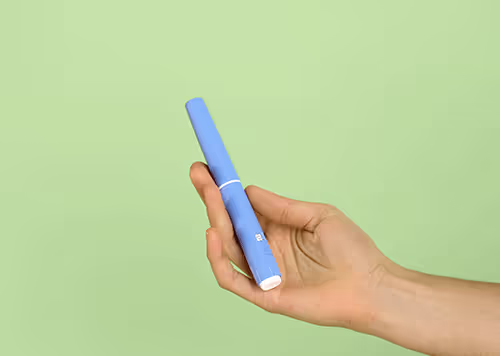
Semaglutide is present in multiple drugs. One is Ozempic, a weekly injection that was developed to help diabetics manage and control blood sugar levels. While it was designed as a diabetes treatment, Ozempic can also be used for weight loss and weight management.
Wegovy is another semaglutide-based weight loss medication that is licensed for the management of weight loss in Canada.
Clinical trials have shown a higher dose of GLP-1 medication to be more effective for weight loss than some of its alternatives.
The study from 2021 looked at 1,961 obese and overweight adults who were randomly assigned the GLP-1 injections or a placebo. After 68 weeks, those taking the GLP-1 lost an average of 15.3kg, whereas the placebo group lost an average of 2.6kg [7].
More recent data on Wegovy’s 7.2mg dose show average weight loss of 20.7% after 72 weeks [8].
Wegovy and Ozempic can both be accessed through Juniper. where it comes as a pre-filled injection pen and only requires a weekly injection.
When is the best time to take Ozempic?
Ozempic is best taken once a week on the same day each week [4]. It can be taken with food or without. The time of day you take the medication doesn't really matter, as long as you are consistently taking it on the same day each week.
How long can you lose weight with Ozempic?
One trial found that after 2 years on semaglutide, patients were still losing weight [5]. Although there is technically no limit to how long you can take semaglutide weekly, at Juniper, our practitioners mostly recommend sticking with the medication for at least a year.
It's important that your weight loss plan is tailored to you; that's why our practitioners will speak to you about the right duration of time to be on the medication, depending on how much weight you are looking to lose, as well as your overall health goals.
It's also important to make lifestyle and habit changes alongside weight loss medication to ensure that you'll continue to experience sustainable weight loss in the long term.
This is why Juniper takes a holistic approach that includes clinically-proven medication as well as health tracking, clinical care and 24/7 access to support.
Can Ozempic cause weight gain?
Both Ozempic and Wegovy can cause some side effects, although the most common side effects are generally temporary as your body adjusts to taking the medicine.
Semaglutide has also been shown in clinical trials by its pharmaceutical manufacturer to be more effective for weight loss compared to other GLP-1 medications. Although many lost weight, some people did gain weight in the trials.
Semaglutide is not usually known to cause weight gain, although some people may experience some initial bloating during the first few weeks.
Why am I not losing weight on Ozempic?
If you're not losing weight on semaglutide, there could be a few reasons why.
1. You're looking for drastic changes, quickly
While semaglutide can help you experience significant weight loss, it does take time. So, if you've just started Wegovy, for example, and are expecting weight loss to happen straight away, it's important to remember that:
a) Everybody reacts to semaglutide differently, and
b) Weight loss always takes patience — even if you are on medication.
Try to approach your journey with the medication as one to help you achieve gradual, sustainable weight loss outcomes.
2. You don't have the right calorie intake
It's still important to be in a caloric deficit to lose weight — meaning you should be consuming fewer calories than you're burning.
That's why we use behavioural science to set you up for sustainable lifestyle changes that will stick (and our dieticians can help you determine what the right deficit for you is).
3. Your dosage might be off
It's required that you start on a dose of 0.25mg for the first 4 weeks, which allows your body to get used to the medicine and helps to reduce the risk of side effects.
After the initial 4 weeks, you can begin increasing the dosage — be sure to talk to your prescriber about this, as you may not have increased your dose, and that could be wreaking havoc with your weight loss efforts.
4. You've hit a plateau
It's normal to eventually hit a point where your weight loss slows down, especially if you're not working on keeping or building up your muscle mass.
Losing muscle along with fat slows your metabolism and can slow down your weight loss. Once your body adjusts, your weight loss journey should pick up again.
5. You haven't found the right healthy lifestyle changes
The true 'secret' to long-term weight management is being able to establish healthy habits like regular exercise and a healthy diet you can actually stick to long-term.
This will ensure you achieve sustainable weight loss and can carry it out into the future.
6. You need a stronger support network
Successful people surround themselves with successful people.
Research shows people have greater success with weight loss when they do it together. Find ways to connect with other people in your community who are also on a weight loss journey. Some ways to do this are by joining a gym or a running club, or finding a support group online.
7. You're not getting enough sleep
Getting at least 8 hours of sleep a night is critical to helping your body lose weight.
Though the exact link between sleep and weight is still under investigation, the main hypothesis is that poor sleep quality may increase your levels of ghrelin and leptin — two hormones that influence your appetite levels.
Plus, some studies have found that sleep-deprived people can often gravitate towards higher-calorie foods [7].
To prevent this, try to practice good sleep hygiene to ensure you're giving yourself the best opportunity for a good night's sleep.
8. You're skipping doses
Just like any other medication, you must take semaglutide according to your clinician's instructions. By sticking to your schedule, you can maximize your treatment response (while also minimizing side effects).
Of course, sometimes life gets in the way, so if, for some reason, you do forget to take a dose (or more) of semaglutide and are unsure what to do, be sure to contact your healthcare provider.
9. You're too stressed
Yes, your stress levels can impact your weight loss results, and they may just be the reason why you're not seeing the results you were hoping for.
This is because excess cortisol levels can promote overeating (making it harder to stick to that caloric deficit we mentioned before), slow down your metabolism, decrease muscle mass, and contribute to sleep hygiene issues.
10. You're not drinking enough water
Staying hydrated is key for pretty much every process in your body, and weight management is no exception. While drinking enough water isn't the only way to lose weight, not doing so can certainly be a barrier to your success.
This is because water can help boost your metabolism, suppress your appetite, reduce cravings, improve your digestion (so your body uses all the nutrients in your food effectively), and make it easier to exercise.
How long does it take for Ozempic to start working for weight loss?
Semaglutide helps reduce cravings and suppress appetite, which helps you consume fewer calories. Each person has a different starting weight, metabolic weight and in some cases, different underlying health conditions.
Once you start on an injectable medication, you may find it takes a few weeks to start seeing results, although some people may see changes in a week.
Your practitioner will start you on the lowest dose of the medication to give your body time to adjust. You’ll begin to notice that your appetite is reduced and you’re experiencing increased satiety.
In general, most people lose a minimum of 5% of their starting weight when they use semaglutide.
How can I maximize my body weight loss on Ozempic?
You can assist the medication by lowering your overall calorie intake, moving your body where possible and limiting your alcohol consumption.
Although there are no specific rules or diets to accompany using semaglutide, reducing the number of processed foods in your diet whilst increasing fibre-rich whole foods can help with lowering your overall calorie intake.
When it comes to exercise, experts recommend adults participate in 150 minutes of moderate activity and 75 minutes of vigorous activity every week [6].
It is also recommended to reduce the amount of time spent sitting and incorporate 2 days per week of strengthening exercises.
Juniper takes a multi-pronged approach to weight loss, helping you meet your goals healthily and sustainably. And, it works: Juniper patients on average have experienced 21.3% weight loss after 12 months [9].
If you are at all concerned about the rate of your weight loss on semaglutide, it's best to consult with your healthcare provider.
Juniper's certified healthcare practitioners are standing by to support you through each stage of your journey as you strive for a healthier lifestyle.
Frequently asked questions
Is it possible not to lose weight on Ozempic?
Most people experience weight loss once on semaglutide, but exceptions may exist. It's possible not to lose weight on semaglutide for several reasons: perhaps you're not on a calorie deficit, you're not on the right dosage, or you're not following your dosing schedule properly. You may have also hit a weight loss plateau, where your body has adjusted to the weight loss brought on by reduced calorie intake and increased physical activity.
How do you break a plateau on Ozempic?
Your doctor can help you overcome a semaglutide plateau by adjusting your dosage, helping you implement lifestyle changes (for example, improving your sleep quality or finding ways to better manage your stress levels), optimizing your workout routine, or improving your eating habits.
How long does it take to lose 20lbs on Ozempic?
Different people lose weight at different rates, but generally speaking, it may take 10-20 weeks to lose 20lbs on semaglutide.
Image credit: Pexels
in 1 year
- No GP referral
- Ongoing expert support
- Trusted by 260,000 members worldwide
“I was always on this yo-yo diet scenario, which never worked. I always just felt hungry throughout the dieting process and it actually kinda gets you down”


“Juniper has been my weight loss miracle, we all need help on our weight loss journey, especially because it gets harder the longer it goes on.”

“Juniper's just given me my confidence back. That's what my friends are saying, “You've got your smile back, you've got your sparkle back,” which I know I'd lost.”
- https://jamanetwork.com/journals/jama/fullarticle/2787907
- https://pubmed.ncbi.nlm.nih.gov/9840447/
- https://dom-pubs.onlinelibrary.wiley.com/doi/10.1111/dom.12932
- https://www.ozempic.com/how-to-take/ozempic-dosing.html
- https://www.nature.com/articles/s41591-022-02026-4
- https://www.gov.uk/government/publications/physical-activity-applying-all-our-health/physical-activity-applying-all-our-health
- https://www.sciencedaily.com/releases/2016/11/161102130724.htm
- https://www.novonordisk.com/content/nncorp/global/en/news-and-media/news-and-ir-materials/news-details.html?id=915087
- Average weight loss results of 998 Juniper UK patients over 12 months (Mounjaro & Wegovy)



.avif)